 中文
中文
 News
NewsIf you are sourcing tempered glass lids, you may have experienced this situation:
You ask several suppliers for a quotation for the same 28cm glass lid, but the prices are surprisingly different.
One supplier offers a very low price. Another is more expensive. A third supplier may quote even higher.
So, which quotation is actually reasonable?
The answer is that tempered glass lids are not simply a combination of glass and a metal rim. Products that look almost identical can have different glass specifications, rim materials, handles, vents, finishing, packaging and production requirements.
That is why buyers should not compare only the unit price.
The real comparison should be based on the complete product specification behind the quotation.
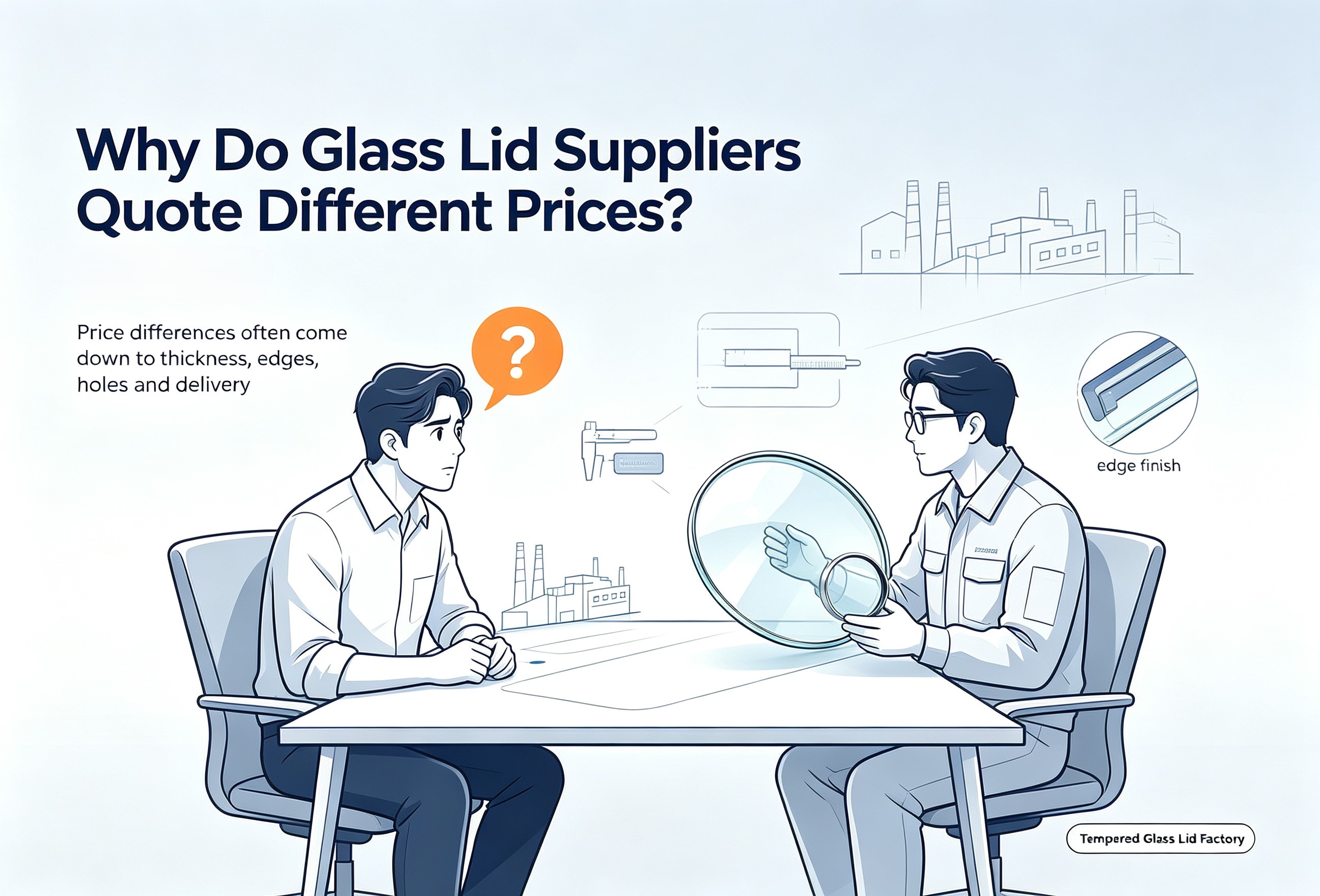
1. First, Check Whether the Glass Specifications Are Really the Same
This is one of the easiest details to overlook when sourcing glass lids.
Two suppliers may both quote for a “28cm tempered glass lid,” but that does not necessarily mean they are quoting exactly the same product.
You should confirm:
- Glass diameter
- Glass thickness
- Glass shape
- Edge processing
- Tempering requirements
- Finished lid diameter
One important point is that the glass diameter and finished lid diameter are not always the same.
If one supplier is quoting a different glass thickness, size or processing requirement, the price difference may be completely reasonable.
Instead of simply saying:
“I need 28cm glass lids.”
it is better to provide a drawing, sample or detailed dimensions.
2. Rim Material Can Make a Significant Difference
The protective rim is another important part of a tempered glass lid.
Common rim materials include:
- Stainless steel
- Aluminum
- Silicone
- Other customized materials
Even when both suppliers quote a stainless steel rim, you should still confirm the material grade, thickness, structure and finishing requirements.
For example, if one supplier quotes according to your specified stainless steel material while another uses a different material specification, the two prices should not be compared directly.
Do not just ask whether the rim is stainless steel. Ask for the actual specification.
3. The Handle and Other Components Also Affect the Price
The handle may look like a small component, but different designs can result in different production costs.
You may need to confirm:
- Handle material
- Handle shape
- Handle size
- Screw and fixing components
- Surface finishing
- Customized logo
For OEM projects, customers may also require a specific handle design.
Other components, such as steam vents, decorative parts and fixing hardware, can also affect the final quotation.
A tempered glass lid quotation is therefore the result of multiple components and production processes, not just the glass itself.
4. OEM Products Should Not Be Compared by Base Price Alone
For standard glass lids, price comparison is relatively straightforward.
For OEM or customized products, it is different.
Your requirements may include:
- Special dimensions
- Customized rim
- Customized handle
- Logo
- Steam vent
- Special finishing
- Customized packaging
All of these requirements can affect product development and production.
This is especially important when the lid needs to match the customer's existing cookware.
The supplier may need to confirm the cookware opening diameter, rim structure and finished lid dimensions before production.
A professional supplier should confirm the product first rather than giving a very low price based on incomplete specifications.
5. Packaging Can Also Explain Price Differences
Another question that cookware buyers often overlook is:
Does the quotation include packaging suitable for export transportation?
For example:
- Bulk packing
- Individual packing
- Color box
- Export carton
- Customized packaging
Glass products require appropriate packaging for transportation.
Two suppliers may offer similar products, but if one uses basic packaging while the other provides packaging designed according to the customer's export requirements, their quotations may naturally be different.
When comparing prices, ask:
“What kind of packaging is included in the quotation?”
Don't look at the unit price alone.
6. Order Quantity Also Affects the Quotation
The price for 1,000 pieces is not necessarily the same as the price for 10,000 pieces.
Order quantity can affect:
- Raw material purchasing
- Production scheduling
- Tooling or fixtures
- Packaging purchasing
- Production efficiency
- Labor and management costs
If you want a more accurate quotation, provide your expected order quantity when sending an inquiry.
If the final quantity is not confirmed yet, you can provide both an initial order and an estimated annual quantity.
For example:
Trial order: 1,000 pcs
Estimated annual quantity: 20,000 pcs
This gives the supplier a better understanding of your project.
7. Why Does One Supplier Sometimes Offer a Surprisingly Low Price?
From a sales perspective, if a customer asks:
“Why is your price higher than another supplier?”
I don't think the best answer is simply:
“Our quality is better.”
A better approach is to compare the complete product specification together.
For example:
Same glass + same thickness + same rim material + same handle + same finishing + same packaging + same quantity
Only when these conditions are basically the same does a price comparison become meaningful.
Otherwise, you may simply be comparing the prices of two different products.
8. What Information Should You Provide When Requesting a Quotation?
If you want a supplier to quote quickly and accurately, provide as much of the following information as possible:
Product information
- Lid type
- Finished lid diameter
- Glass diameter
- Glass thickness
- Rim material
- Handle/knob
- Steam vent
- Logo requirements
- Packaging requirements
- Order quantity
- Destination market
If you already have a sample or technical drawing, send it together with your inquiry.
For OEM projects, a clear drawing or physical sample can sometimes communicate more than a long product description.
9. The Lowest Quotation Is Not Always the Best Quotation
The goal of sourcing is not simply to find the supplier with the lowest number.
The more important question is:
Does the quoted price represent the product you actually need?
If a supplier offers a low price but you later need to change the dimensions, material or packaging, the initial saving may disappear through additional costs and communication.
On the other hand, when a supplier confirms the product specifications, production requirements and packaging before quoting, the purchasing process is usually much clearer.
10. From a Sales Perspective, This Is How We Prefer to Receive an Inquiry
If you are sourcing tempered glass lids, instead of simply asking:
“What is your best price?”
you can provide your specifications and say:
“Here are our product specifications. Please check whether you can manufacture them and send us your quotation.”
The difference may look small, but it changes the entire conversation.
The first question is about price.
The second is about a real purchasing project.
For an OEM manufacturer, confirming the product before discussing the price is usually a much more efficient way to start a business relationship.
About Shixing
Shixing has been manufacturing tempered glass lids and related cookware lid products since 1999, serving cookware customers and OEM projects in different markets.
When customers ask us for a quotation, we do not look only at a number such as “28cm” or “30cm.”
We first want to understand:
What structure does the lid need? What are the dimensions? What materials are required? What kind of packaging is needed?
Because for a buyer, the most valuable quotation is not simply the lowest price.
It is a quotation that accurately matches the final product and can actually be used for purchasing.
If you are sourcing tempered glass lids, you can send us your dimensions, drawings, sample photos or existing lid information.
Let's confirm the product first, then discuss the price.
That is often a better way to start a long-term cooperation.